Every farm is a web of relationships.
 Grade
 Time
 Final product
A regional food system is made up of people, places, and choices. Knowing the farms in our region helps us understand where our food comes from, who grows it, and why their work matters to our health, our economy, and our community.
Who grows our food, and why does their work matter to our community?
In one 50-minute class period, students become investigators of their regional food system. After a brief opening inquiry (“Where does our food come from? Could you name a farm in our region?”) and a quick vocabulary preview, pairs are each assigned one local or regional farm to research.
Using farm websites, news articles, and farm directories, pairs complete a Farm Profile and build a 2-slide presentation: one slide introducing the farm and one slide explaining why it matters environmentally, economically, and to the community.
The class closes by plotting each researched farm on a regional map, surfacing patterns about where food in their community actually comes from. The slide deck and the regional map become a shared, growing artifact across the unit.
Apply scientific principles to design methods for monitoring and minimizing human impacts on the environment, applied to local agriculture. Analyze interactions among organisms and between living and nonliving parts of ecosystems, applied to farming systems.
Three-dimensional emphasis. SEPs: Obtaining, Evaluating, and Communicating Information; Developing and Using Models (maps as system models); Asking Questions. CCCs: Systems and System Models; Cause and Effect; Stability and Change.
MS-ESS3-3 MS-LS2-1Cite textual evidence to support analysis of informational texts about farms and food systems. Write an informative explanation of the assigned farm. Present findings clearly, sequencing ideas logically and using relevant evidence.
RST.6-8.1 WHST.6-8.2 SL.6.4/7.4/8.4Construct maps and explain geographic relationships related to farms and food systems. Explain how economic decisions in agriculture and food production affect the well-being of farmers, businesses, and communities.
D2.Geo.1.6-8 D2.Eco.1.6-8Explain how food production and farming practices connect to human and environmental health. Analyze how community, economic, and cultural factors influence farming practices.
NHES 1 NHES 2A regional food system is made up of the people, places, and steps involved in bringing food to a community. Farmers, as stewards of the land, are central actors in that system. Their decisions about soil health, water use, crop diversity, and animal welfare ripple through the environment, the economy, and local communities.
When middle school students investigate their regional food system, they begin to see how geography influences food production. Climate, soil type, access to water, and distance to markets all influence what farms grow and how they operate.
Many students will discover farms they’ve passed in a car or seen at a farmers market but never investigated. Others, especially those in rural communities or families connected to agriculture, may already have first-hand knowledge to bring in. The lesson is designed to honor both starting points.
Introduce the five terms via the vocabulary slides before pairs begin their research.
All the people, places, and steps involved in bringing food to our community.
A place where crops are grown or animals are raised for food.
Food grown and produced close to where it is eaten, usually within the same region.
The time of year when certain foods are naturally harvested in a region.
Paying a farm in advance for a share of its harvest, delivered as regular boxes of fresh, seasonal food.
Google files open as your own editable copy. Want it all? Download the whole lesson in one ZIP. Teaching the whole unit? Download all 7 lessons or open the unit in Google Drive.
Courtesy of City Roots Farm: Real Organic Certified
Share quick answers to: Where does our food come from? Could you name a regional farm?
If your family has connections to farming or food work, share one thing you’ve learned.
Read along with the vocabulary slides; ask clarifying questions.
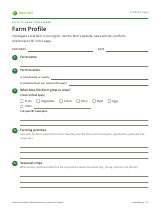
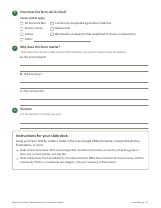
Find your partner and examine the Farm Profile page so you know what you’re looking for.
Complete the Farm Profile together using the farm’s website, news articles, and directories.
Mark inferences with a question mark: guess thoughtfully when a website doesn’t say directly.
Circle the one most surprising thing you learned.
Build your two slides using research from the Farm Profile: complete sentences, cite at least 1 source.
Spend 2 min at the end to peer-scan with another pair: spot anything missing.
Place your pair’s dot on the regional map and label the farm name.
Notice the patterns: where are the farms? How far is food traveling?
Share one reason farming matters to your community.
Students demonstrate understanding by:
Look-fors: pairs that ask honest questions about their farm’s practices (rather than just praising them) are demonstrating stronger informational analysis.
Rural and farming-family students. In rural districts, some students will have direct family ties to conventional, organic, or regenerative farming. Treat all farming approaches respectfully: the lesson is about understanding the food system, not ranking the farms. Family knowledge is a resource; invite it.
Urban students. Most urban students have not visited a working farm. Show photos and videos generously, and lean into farms students may have encountered indirectly: community gardens, school gardens, urban farms, farmers markets.
Timing note. The 50-min flow is tight. If the slide build runs over 15 min, plan a short follow-up day (15–20 min) for slide completion and the regional map share-out.
Students prepare 3–5 questions and interview a farmer at their researched farm by phone, email, or in person at a farmers market. They summarize insights about farming practices, seasonality, and community relationships, and add what they learn to their slides.
Arrange a class visit to a nearby farm. Students observe crops, soil practices, irrigation, and harvesting. Before the visit, they generate three questions tied to their research; after, they compare what they observed to what they read online.
Students expand the classroom map to include multiple farms across the region, plus distribution centers, farmers markets, and grocery stores. They analyze patterns (clusters, gaps, distance) and identify potential Farm to School connections in their district.
Students analyze their researched farm’s crops and design a realistic school lunch item that could feature one of its seasonal products. They calculate approximate harvest timing, estimate quantities, and discuss whether the farm could realistically supply the school cafeteria. Could pair with a visit to the school food service director.
Students research how one crop from their farm is used in different cultural cuisines around the world. They create a short slide or poster showing recipes, traditions, and celebrations connected to that food, and reflect on how Farm to School and farmers market programs can honor cultural diversity in a community.
Know Your Farmer (Nigel Walker, ~1:30 min): Walker reflects on what it means to grow food for a community. Use as a class opener if a 5-min budget can be found, or share as a follow-up during Farm Investigation.