
About the Film
Nourish: Food + Community opens with a simple question: what’s the story of your food? In 26 minutes, the award-winning PBS special follows that story from our global community to a single meal, and ends with steps anyone can take to build a healthier food system.
Hosted and narrated by Cameron Diaz, the film features journalist Michael Pollan, healthy food advocate Anna Lappé, chef Bryant Terry, pediatrician Dr. Nadine Burke, and organic farmer Nigel Walker, along with the voices of young people.
Who This Guide Is For
The guide is written for teachers from grade 4 up, and it works just as well for a library, a faith community, or friends around a table. It is free to use, and it comes with every streaming license.
The Four Segments
The film has four segments, three to eight minutes each. Show it straight through, or pause after each segment to talk. Start times are for the streaming version.
1. Connections
starts at 0:50
Food stories from around the world: a fruit salad in Chicago, a fish market in Tokyo, an urban farm in Brooklyn, cocoa growers in Ghana, and a café serving only food grown within 150 miles.
2. Seed to Table
starts at 7:28
Two crops, two paths. Commodity corn is grown as a monocrop with chemical fertilizers and processed into packaged food. An heirloom tomato is grown organically and sold at a farmers market.
3. Vote With Your Fork
starts at 16:14
Michael Pollan traces how processed food became the norm, and what it has cost our health and the environment. Every meal, he argues, is a chance to vote for what we care about.
4. Be the Difference
starts at 21:50
The film closes with six kinds of action anyone can start this week: teach and learn, grow your own, create community, change the menu, shop wisely, and take a stand.
Plan Your Screening
Choose a plan that fits your time and goals.
One class period. Show the whole film (26 minutes) and leave 15 to 20 minutes for discussion.
Four short sessions. Show one segment a day with its questions below. If you have five more minutes, pair it with a short film.
A unit launch. Show the film before Lesson 1, The Story of Food, in either the elementary or the middle school unit. Return to Be the Difference at the end of the unit, as students prepare their Food System Expo (grades 4–5) or their action projects (grades 6–8).
Pair a Segment with a Short Film
Each Nourish short film runs one to three minutes and has three discussion questions of its own on its page.
| Segment | Short films |
|---|---|
| Connections | Food and Biodiversity, Fair Trade |
| Seed to Table | Monocrops, Heirlooms |
| Vote With Your Fork | Real vs. Fake Food, Whole and Healthy |
| Be the Difference | Be the Change, Youth Making Change |
Before You Watch
Write the word nourish on the board and ask what it means. When something is described as nourishing, what comes to mind? Does nourishment always come from food? What else nourishes us?
Hand out Nourish Notes, the student page in the PDF, for students to fill in as they watch. Afterward, have them compare answers in pairs, in groups, or as a class, using the answer key.
Nourish Notes
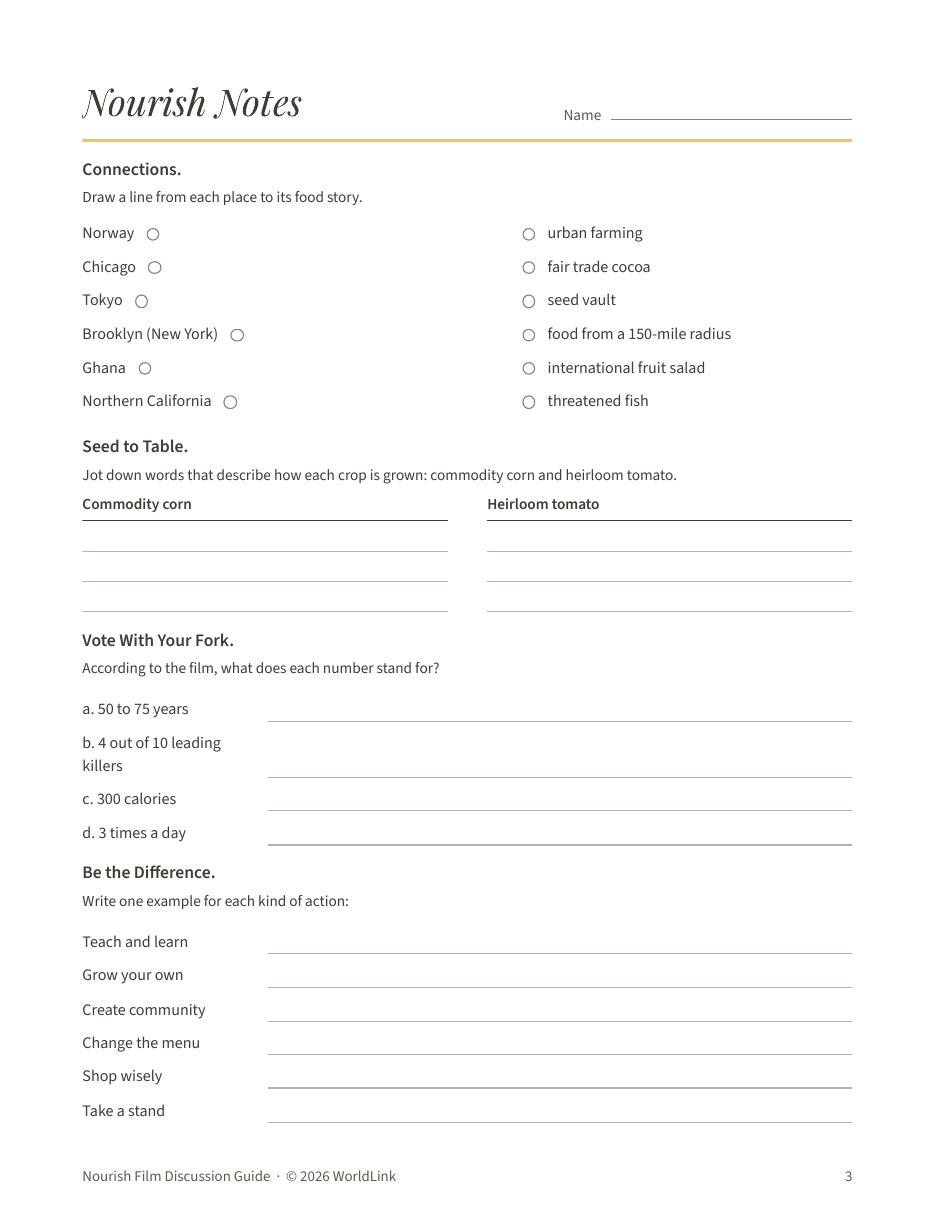
Nourish Notes is a one-page worksheet in the PDF, for students to fill in as they watch. Print one copy per student. The answer key is on the next page of the PDF, so the worksheet prints without it.
Download the guide (PDF)Answer Key
Connections: Norway, seed vault; Chicago, international fruit salad; Tokyo, threatened fish; Brooklyn, urban farming; Ghana, fair trade cocoa; Northern California, food from a 150-mile radius.
Seed to Table: possible answers. Commodity corn: industrial farm, monocrop, pests, pesticides, chemical fertilizers, runoff. Heirloom tomato: organic, manure, close to customers.
Vote With Your Fork: a. how long ago the Western diet was invented; b. four of the ten leading causes of death are chronic diseases linked to food; c. how many more calories a day people eat than before 1980; d. how often each of us can “vote” for the food system we want.
Source for b: Michael Pollan in the film. Heart disease, cancer, stroke, and diabetes are still among the ten leading causes of death in the United States (Centers for Disease Control and Prevention, National Center for Health Statistics, Mortality in the United States, 2023, Data Brief No. 521, December 2024).
Be the Difference: possible answers. Teach and learn: ask where your food comes from; find out what grows nearby. Grow your own: plant herbs or vegetables. Create community: cook a meal with others; meet the people who grow your food. Change the menu: eat more vegetables, fruits, and whole grains. Shop wisely: read labels; choose organic or fair trade. Take a stand: join a group working on food issues; learn how policy shapes what we eat.
Discussion Questions
Choose one or two from each list. Start with an opening question and end with a closing one.
Opening
What did you eat today? How much do you know about its story?
What in the film was new to you? What surprised you?
Connections
Think of something you ate this week. Where in the world might its story begin?
If you ate only food grown within 150 miles of here, like the café in the film, what could you eat? What would you miss? How would the seasons change your meals?
Seed to Table
How were the paths of the commodity corn and the heirloom tomato different? Were they alike in any way?
Bryant Terry argues that a tomato grown well is worth paying a little more for. Do you agree? Why or why not?
Vote With Your Fork
Michael Pollan says, “Food is not just fuel. Food is about family, food is about community, food is about identity.” What does he mean? Give an example from your own life.
What does it mean to “vote with your fork”? What are you voting for with the food you eat now?
Be the Difference
The film names six kinds of action. Which one could you start this week? What would help you do it?
The film ends where it began: what’s the story of your food? How might knowing that story change what you choose?
Closing
What’s one thing from the film you’d like to share with your family or friends?
What would a healthy food system look like where you live?
After the Film
Write. Show the three-minute short film Nourish Means… and ask students to write a paragraph about one way their idea of nourishment has grown.
Think-Pair-Share. Pose one question. Give everyone two minutes to think and jot down ideas, then two minutes each to talk with a partner, then invite pairs to share with the whole group.
Act. Each of the six Act themes opens with something to do tonight. Ask each student to choose one.
Share. Tell us what happened. Stories from classrooms like yours appear in Nourish in Action.
Leading a Good Discussion
Set a few ground rules. One voice at a time, comments kept short, and respect for every view.
Welcome every answer. There are no wrong answers in a conversation. If talk drifts, a question brings everyone back.
Make room for everyone. If a few voices dominate, invite those who haven’t spoken.
Listen for threads. Connect comments as you go, and name the common themes when you sum up.
Lead by example. Model the listening you hope to see.
Beyond the Classroom
The same plan works for a library screening, a faith community’s supper, or friends around a table. Begin with a meal or a short film, show the film or one segment, and choose three or four questions, starting with an opening question and ending with a closing one. For a warm-up, try a round of Table Talk, the free Nourish conversation game.
For more ways to bring Nourish to your school, workplace, or neighborhood, see How to Share Nourish.
Where to Watch
Stream Nourish: Food + Community with a single or site license from the Nourish Store. Every license also covers library and community screenings. Watch the trailer and meet the voices on The Film page. All 52 Nourish short films stream free in Videos.
Adapted from the Viewing Guide in the original Nourish Curriculum, developed in partnership with the Center for Ecoliteracy.