Be the difference that makes a difference.
 Grade
 Time
 Final product
Small actions can shift larger systems. Across a 4-day design sprint, students discover food system challenges, define one their team can tackle, design a realistic action, and deliver a pitch. The activity builds habits that informed choices and collective action can nourish people and planet.
How can our actions help create a healthier food system for people, communities, and the environment?
Food acts as a mirror of our values and culture. When we sit down for a meal, we become part of a much larger story: a cooperative web of people and places that bring food to our community. The food system offers abundant opportunities for young people to take action and make a difference. Even small steps can lead to meaningful change.
This lesson is a 4-day design sprint that scaffolds students from awareness to action. Day 1 (Discover) opens with a Food System Issues brainstorm and an Issues Menu of 10 starter challenges. Each student maps one issue using the Issue Web. Day 2 (Define) forms teams around shared interests, synthesizes team thinking, and produces a “How Might We…” statement that names a specific problem the team will work on.
Day 3 (Design) generates many possible solutions, then narrows them through a Feasibility Filter. Teams choose ONE project and begin the Action Project Plan. Day 4 (Deliver) finalizes the plan and pitch slides, then teams present 3-minute pitches to peers, and close with a personal commitment to a next step. Optional Day 5: implementation kickoff. Teams begin actually doing the project, with the teacher coaching and the class committing to a follow-up check-in 2–4 weeks later.
Evaluate competing design solutions for maintaining biodiversity and ecosystem services, applied to food system action choices. Apply scientific principles to design methods for monitoring and minimizing human impacts on the environment. Analyze interactions among living and nonliving components of food systems.
Three-dimensional emphasis. SEPs: Asking Questions and Defining Problems; Designing Solutions; Obtaining, Evaluating, and Communicating Information. CCCs: Systems and System Models; Cause and Effect; Stability and Change.
MS-LS2-5 MS-ESS3-3 MS-LS2-1Integrate information from texts, images, and data to define a food system challenge. Engage effectively in collaborative team deliberation. Present claims and findings with relevant evidence and clear organization. Write arguments supported by evidence for the team pitch.
RST.6-8.7 SL.6.1/7.1/8.1 SL.6.4/7.4/8.4 WHST.6-8.1Explain how economic decisions affect the well-being of individuals, businesses, and society. Apply civic principles by deliberating in a team to address community challenges. Describe ways individuals and groups can take action to address community challenges.
D2.Eco.1.6-8 D2.Civ.7.6-8 D2.Civ.14.6-8Analyze how food systems influence personal and community health. Analyze how community factors influence food and health behaviors. Advocate for actions that promote healthier communities.
NHES 1 NHES 2 NHES 8Action projects work best when students choose problems they actually care about.
Watch for scope. Students often pick problems too big to address (“end world hunger”); the Feasibility Filter and Day 2 “How Might We” pull them toward problems that are local, specific, and within reach.
Introduce these terms across Days 1 and 3.
All the people, places, and steps involved in bringing food to our community.
A place in a system where a small change can lead to a big result.
A project that young people plan and lead to make a positive change in a system.
See every term in the Visual Glossary
Set B, Day 3How realistic and achievable a project is given the time, materials, and people available.
The meaningful change a project creates for people, communities, or the environment.
Google files open as your own editable copy. Want it all? Download the whole lesson in one ZIP. Teaching the whole unit? Download all 7 lessons or open the unit in Google Drive.
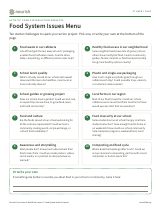
Silently write 3+ things that bother you or excite you about food in our school/community.
Share aloud; add to the class brainstorm.
Pair share: which issue pulls you in most?
Read the Menu and compare to your brainstorm.
Choose ONE issue (or write your own under Other) for Part 1.
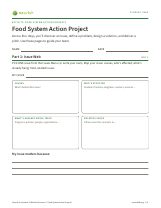
Read Part 1 instructions.
Build your Issue Web: causes, affected groups, related issues, what’s already happening.
Circle the part that excites you most.
Share your issue and one connection from your web.
Notice who else is interested in your topic.
Write: “My issue matters because…”
Find 2–3 classmates with a shared interest and settle into a workspace with your Issue Web.
Combine your individual Issue Webs into one team Issue Web on chart paper.
Synthesize, don’t just append. Look for agreement and disagreement.
Circle 2–3 most promising leverage points.
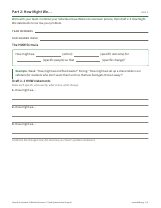
Listen to the How Might We definition and the formula.
Compare the weak vs. strong HMW examples. Why is the second one better?
Draft 2–3 HMW statements as a team on Part 2.
Make each specific: who, what action, what change.
Underline your strongest HMW.
Post your team Issue Web + HMW.
Walk past at least 3 other teams’ HMWs.
Notice what’s specific and what could be sharper.
Re-join your team and reread the 2–3 Issues Menu challenges that connect to your HMW.
Notice the ideas for action in each one.
Brainstorm at least 10 solution ideas on Part 3.
Quantity over quality. Wild ideas welcome. No critique yet.
Add ideas inspired by the Issues Menu.
Score your top 4–5 ideas on the Feasibility Filter (4 dimensions, 1–5 each).
Pick the ONE project with the highest score (or score plus team consensus).
Mark your chosen project clearly.
Complete Part 4: Action Project Plan.
Be specific on each section: goal, steps, materials, people, metric, timeline.
Identify ONE concrete first action for this week.
Note what your team still needs to finish.
Plan who will draft what before Day 4.
Finalize your plan and build the 4-slide pitch deck.
Decide who will speak each section.
Pitch your project in 3 minutes: problem, solution, why it matters, and the plan.
Answer 1–2 questions from classmates.
Listen actively to other teams; leave specific feedback for each.
Share one pattern across the projects.
Write a personal commitment: “My next step this week is…”
Post your commitment on the class wall.
Decide as a team: do we want to keep going with this project beyond class?
Take your Action Project Plan with you.
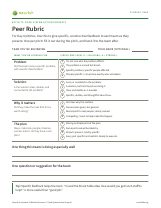
Students demonstrate understanding by:
Look-fors: tight scope is the strongest signal of project quality. Teams that narrow to a specific stakeholder and a specific action will outperform teams that stay broad.
Authenticity matters. The more real this is, the more students invest. If you can invite a community partner (local farmer, food bank coordinator, school food service director) for Day 4, do it. Their presence raises the bar without raising the workload.
Implementation is optional but powerful. Some teams will want to actually do their project. Set aside a Day 5 (or stretch into the next week) to support implementation. Even partial implementation builds civic agency.
Equity in voice. The team structure surfaces all roles, but some students still talk more than others. Build in silent journaling between major decisions; require each team member to speak at least once during the pitch.
Teams actually carry out the project they designed. Over 2–4 weeks, teams gather materials, contact stakeholders, run the action, and collect simple data to measure results. At the end, students reflect on what they accomplished, the impact of their actions, and how their project could be improved or expanded. This is the single most powerful follow-on for civic agency.
Students conduct a structured food waste audit at lunch, observing and recording food discarded across several lunch periods, then categorizing the waste by type (untouched food, partially eaten, packaging). They analyze findings and propose strategies (share tables, composting, portion adjustments) to reduce waste.
Students research where foods served in their school cafeteria come from, identify which items are locally or regionally produced, and create a map or visual display showing the journey of several foods from farm to school. They propose ways the school could increase its use of local foods.
Students investigate access to healthy food in their local community by mapping grocery stores, farmers markets, community gardens, and food banks. They analyze patterns in food access and discuss how communities can work together to ensure everyone has nourishing food.
Students research careers connected to the food system: farmers, soil scientists, chefs, dietitians, food entrepreneurs, farm-to-school directors. They choose a career and create a short presentation explaining how it contributes to a healthy, regenerative food future.
Students create a campaign that encourages healthier or more sustainable food choices in their school: posters, announcements, social media messages, or short videos explaining how small changes (reducing waste, choosing local) can improve the food system.