Healthy farms grow from healthy systems.
 Grade
 Time
 Final product
Regenerative farming works because it weaves soil, water, biodiversity, climate, food, and community into one interdependent system. Communities benefit when farmers see those connections.
Why does the way we farm matter to our community, our health, and the planet?
Across two class periods, students step into the roles of farmers, scientists, community advocates, and policy thinkers as they collaboratively address real challenges facing a regenerative farm (an approach that overlaps with organic farming).
Day 1 opens with the Nourish short film From the Soil and builds shared vocabulary, then students sketch the connections of a healthy farm system, view the Regenerative Farm exhibit, and receive their roles. They visit three to five Research Stations to build their expertise and complete a Role Description.
Day 2 brings teams together for four rounds of cooperative role-play: Soil and Water Foundations, Biodiversity Builders, Food and Community, and Climate and the Future. Each round, teams advocate for a farm action that fits their roles, then post their consensus action at the Class Board. The lesson closes with a gallery walk across all four rounds and a whole-class reflection on what makes a farm — and a community — resilient.
Develop and use a model to describe the cycling of matter and flow of energy among living and nonliving parts of an ecosystem, applied to a regenerative farming system. Evaluate competing design solutions for maintaining biodiversity and ecosystem services, applied to a farming community’s choices. Apply scientific principles to design methods for monitoring and minimizing human impacts on the environment, including soil health, water use, and biodiversity in agriculture.
Three-dimensional emphasis. SEPs: Developing and Using Models; Engaging in Argument from Evidence; Constructing Explanations and Designing Solutions. CCCs: Systems and System Models; Cause and Effect; Stability and Change.
MS-LS2-3 MS-LS2-5 MS-ESS3-3Integrate information from texts, images, and diagrams to build understanding of a complex system. Engage effectively in collaborative discussions, building on others’ ideas and expressing ideas clearly. Write informative explanations supported by evidence and clear reasoning (Role Description + extension persuasive piece).
RST.6-8.7 SL.6.1/7.1/8.1 WHST.6-8.2Explain how economic decisions in agriculture and food production affect the well-being of farmers, businesses, and communities. Apply civic principles by deliberating in a multi-role group to address farming and community challenges.
D2.Eco.1.6-8 D2.Civ.7.6-8Explain how soil health, biodiversity, and farming practices connect to human and environmental health. Analyze how community, economic, and cultural factors influence those practices.
NHES 1 NHES 2Regenerative agriculture aims to restore soil, water, biodiversity, and community, not just maintain them. Its guiding question: “Is the farm healthier this year than last year, in every dimension?”
Because a farm is a system, this is a systems lesson. The four rounds are designed to surface the interdependence of soil, water, biodiversity, food access, climate, labor, and community storytelling. No single role can solve a round on its own; each round requires several roles to weigh in. Encourage students to make connections across rounds: a decision made in Round 1 (e.g., cover crops) may directly support a Round 4 challenge (climate resilience).
Introduce the first set on Day 1 before the brainstorm. Let the rest emerge through the Research Stations.
A way of farming that restores soil, water, and biodiversity, leaving the land healthier than before.
How well soil works as a living system that supports plants, animals, and people.
The benefits healthy ecosystems provide to people, such as clean water, pollination, and fertile soil.
The variety of living things in an area, from plants and animals to the life in the soil.
Plants grown to protect and feed the soil between food crops, instead of leaving the soil bare.
See every term in the Visual Glossary
Set B, Encounter as you visit stations (Day 1)Food scraps and yard waste broken down into nutrient-rich soil.
Changing which crop is grown in a field each season to support soil health.
The process of trapping carbon in soil or plants to reduce greenhouse gases in the atmosphere.
Animals like bees, butterflies, and birds that move pollen between flowers, allowing many crops to grow.
Google files open as your own editable copy. Want it all? Download the whole lesson in one ZIP. Teaching the whole unit? Download all 7 lessons or open the unit in Google Drive.
Courtesy of Better Together Farm: Real Organic Certified
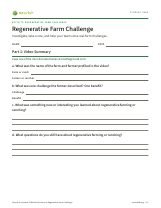
Assign Part 1 (Video Summary) of the student pages the day before: each student watches one Kiss the Ground mini-documentary and answers the four questions.
Watch From the Soil and listen for one thing that surprises you about soil.
Share with a partner what surprised you and any family connection to soil or growing.
Read along with vocabulary; ask clarifying questions.
Try to name one example from your own life for one term.
Brainstorm aloud: what does a healthy farm need to thrive?
Spend 3 silent minutes sketching the connections you imagine: between soil, water, animals, plants, and people.
Share one sketch with the class if invited.
Compare the exhibit’s farm model to your sketch.
Share one connection that’s the same and one that’s different.
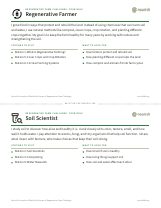
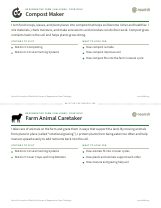
Receive your role. Read the half sheet.
If you’d like to swap for a role with a stronger personal or family connection, ask once before the class moves on.
Notice which roles your teammates have.
Visit at least 3 Research Stations relevant to your role.
Bold words are vocabulary you should know.
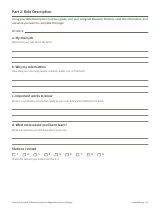
Read your card twice. Take notes on Part 2 of your student page.
Look at the Class Board structure: 4 rounds × 1 action per round = 4 team actions total.
Finish your Part 2 Role Description as homework if needed.
Predict which rounds your role will matter most.
Find your team. Confirm you have a mix of role categories.
Re-read your Role Description card.
Read the sentence stem on the board. You’ll use it every round.
Silent journal: What do I, in my role, advocate for? Why?
Team deliberation: each role uses the sentence stem. Listen as well as speak.
Consensus: your team agrees on ONE team action.
Post: write your team’s action on a Post-it. Include role(s) consulted + action. Place at Class Board under Round 1.
Silent journal: what does YOUR role notice that the Biodiversity roles might miss?
Team deliberation + consensus + post.
Silent journal: what does the community need most right now?
Team deliberation + consensus + post.
Silent journal: what action would matter most in 20 years?
Team deliberation + consensus + post.
Notice: did your team’s earlier choices set up this round?
Walk past all four columns of the Class Board. Read at least one team action per round.
Leave one “+” sticky on a team action you support.
Share one pattern or surprise from the rounds.
Students demonstrate understanding by:
Look-fors: the silent journal between rounds registers individual thinking and gives quieter voices a place. Use journals + Class Board posts + Part 2 student page together for a full picture.
Pre-work realism. Some students may not complete Part 1 at home. The Day 1 Step 1 screening of From the Soil works as a fallback; capture key answers to the four Part 1 questions on the board so all students leave Day 1 with Part 1 completed.
Role-play culture. The role-play depends on students taking their roles seriously. If you teach a class where role-play is new, model it briefly at the start of Round 1: play the Compost Maker yourself for 30 seconds using the sentence stem.
Rural and urban contexts. In rural districts, students may have family members in conventional agriculture; treat conventional farming as a real choice under real constraints. In urban districts, lean into Pie Ranch (Station 8) and other examples that include school gardens, community gardens, and urban agriculture as legitimate regenerative paths.
Students write a short letter to a farmer in their region: they introduce themselves, share one thing they learned about how farms work as systems, and ask what challenges the farmer is facing on their land. If the class mails the letters, any replies become a powerful follow-up discussion.
Invite 2–3 local farmers, gardeners, food-system advocates, or land-use planners to a class panel. Students prepare 3 questions in advance from their role’s perspective and record the responses. After the panel, students compare what they heard to the Regenerative Farm exhibit.
Students choose a Kiss the Ground mini-documentary (or a related Nourish short film) they didn’t watch for Part 1, then create a 60-second video summary (phone-recorded) for the class. The summary includes: farm name, place, one practice, one impact, one question.
Arrange a class visit to a nearby regenerative or organic farm, or schedule a virtual farm tour via video call. Before the visit, each student prepares one question from their role’s perspective. After, students update their Role Description with what they observed.
Bring the role-play out of the simulation. Students choose one of the four Class Board actions and translate it into a real action the class could take this semester: supporting a local farm, starting a school garden, hosting a Farm to School lunch, writing a letter to a local representative. Build a one-page Class Action Plan with steps, roles, and a timeline.