Middle School

Food Traditions

The story of food is embedded in the stories of who we are.

Lesson
03 / 07 Download this lesson
Grade
Grades 6–8
Time
Two class periods, plus a family interview
Final product
Venn diagram + Class Cookbook entry
Big idea

Food traditions are one of the most enduring expressions of culture. Around the globe, food marks holidays, rituals, and family gatherings. Sharing those traditions builds community and identity.

Essential question

What can we learn about our culture and one another through the foods we eat?

Activity overview

Every recipe carries a story.

Across two class periods, students explore how food traditions reflect culture and identity.

Day 1 opens with a Michael Pollan quote and introduces core vocabulary, then teaches interview skills through an in-class mini-practice. Students go home with the Family Food Tradition Interview and interview a family or community member between days. Day 2 brings students together to share what they learned, build a small-group Venn diagram, contribute one entry to a Class Cookbook, and close with a written reflection connecting food to identity.

Depth over speed: the take-home interview yields richer material than in-class peer interviews and honors students’ families as knowledge holders.

Standards alignment

Three subjects, one lesson.

ELA (CCSS)

What students do

Engage in collaborative discussions about food, culture, and identity. Conduct a brief interview and record information. Write informative or narrative reflections about food traditions. Report orally on a topic clearly, sequencing ideas logically.

SL.6.1/7.1/8.1   WHST.6-8.7   W.6.3/7.3/8.3   SL.6.4/7.4/8.4
Social Studies (C3)

What students do

Explain how cultural patterns and economic choices influence how people live and eat. Analyze how food traditions change over time and reflect historical developments. Explain how food practices contribute to identity, community, and cultural continuity.

D2.Geo.6.6-8   D2.His.2.6-8   D2.Civ.10.6-8
Health (NHES)

What students do

Analyze how family, culture, and media influence food choices and health. Demonstrate communication skills that support respectful conversations about food and culture. Value diverse food traditions as part of healthy communities and identity.

NHES 2   NHES 4   NHES 8
Background for teachers

What to know before you teach.

Food is much more than a tool for survival. It is also a source of pleasure, comfort, and connection. While food nourishes our bodies, it also nourishes our families and our communities.

Food traditions are one of the most enduring expressions of culture. Around the globe, food marks holidays, rituals, and family gatherings. For special occasions (and even for daily meals), culture often determines what, when, and how we eat. These traditions connect us to our history, our locale, and to one another.

Food cultures also represent wisdom gained and shared over thousands of years of experimentation. The grains and beans found in many food traditions, for example, provide the perfect combination of amino acids our bodies need.

Vocabulary

Words to grow on.

Introduce all three terms after the Pollan opener on Day 1.

food culture

How a group of people prepare and share food, shaped by their history, place, and values.

food traditions

Foods, recipes, and eating practices that families or communities pass down over time.

identity

How a person understands who they are, shaped by experiences, culture, family, and community.

Materials & preparation

What you’ll print and cue up.

Materials

  • Michael Pollan quote slides: two quotes from the Nourish film, one for the Day 1 opener and one for the Day 2 closing reflection.
  • Visual glossary slides: one per term.
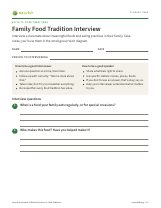
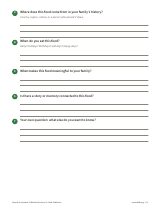
  • Family Food Tradition Interview student page: printable PDF, 1 per student; guided questions for interviewing a family or community member.
  • Blank paper and colored markers: or a digital whiteboard for the Day 2 small-group Venn diagrams.
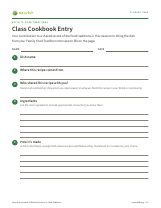
  • Class Cookbook entry template: printable PDF or shared digital template; 1 per student; recipe + short story space.
  • Optional: photos or artifacts from home students may bring photos or small items to share on Day 2.

Preparation

  • Cue up the Michael Pollan quote slides and the Visual Glossary.
  • Print the Family Food Tradition Interview student page (1 per student); students will take this home between Day 1 and Day 2.
  • Set the tone: this lesson treats all food traditions with respect. Plan to address any classroom culture concerns at the start of Day 1.
  • Print or set up the Class Cookbook entry template. Decide whether the cookbook will be paper (stapled or bound) or digital (a shared slide deck or document).
  • Plan Day 2 group composition: groups of 3 work well; students with shared interests or with different food traditions both work.

Download this lesson.

Teacher materials: the teacher guide and the lesson slides

Google files open as your own editable copy. Want it all? Download the whole lesson in one ZIP. Teaching the whole unit? Download all 7 lessons or open the unit in Google Drive.

50 minutes

Day 1

What is food culture?

1

Pollan quote opener

8 min

Teacher

  • Project the Pollan quote slide: “There is a lot of cultural wisdom in food. And indeed, that’s how we knew what to eat for all this time. We didn’t have scientists. We didn’t have industry hawking products at us. We had food culture.”
  • Read the quote aloud slowly. Pause. Ask: “What do you think Michael Pollan means by ‘food culture’?”
  • Invite 4–5 student ideas. Capture key phrases on the board.
  • Affirm: long before nutrition labels, families and communities figured out what to eat, and passed that wisdom down through cooking.

Students

Share an idea about what “food culture” means, or build on a classmate’s.

2

Vocabulary

4 min

Teacher

  • Project the Visual Glossary. Walk through the three core terms: image, term, definition.
  • After each, ask: “Can you think of an example from your own life?”

Students

Share one example of each term from your own life.

3

Introduce the take-home interview

10 min

Teacher

  • Distribute the Family Food Tradition Interview student page. Read the interview questions together as a class.
  • Frame the assignment: “Tonight or this week, interview a family or community member: a parent, grandparent, aunt/uncle, older sibling, neighbor. Someone who can tell you the story of a food that matters to your family.”
  • Coach on interview skills: ask open questions, listen more than you talk, take notes as they speak (not word-for-word, just phrases you want to remember), thank them at the end.
  • Preview return: on Day 2, students will share what they learned and build a small-group Venn diagram comparing traditions across their groups.

Students

Read the Family Food Tradition Interview page.

Think: who in my family might have a story worth hearing?

Plan when you’ll do the interview before Day 2.

4

Mini-practice interview

20 min

Teacher

  • Pair students up. Set a timer: 8 min per round, 2 rounds, plus 4 min for a quick debrief.
  • Round 1: one partner is the interviewer, the other is the speaker. Use just the first three questions on the Interview page.
  • Round 2: swap roles.
  • Debrief: “What made a good question? What made a good answer? What was hard?”
  • Emphasize: the mini-practice was to build the skill; the real interview happens at home, with someone older, on a food that carries family meaning.

Students

Practice interviewing your partner about a food they know.

Swap roles after the first round.

Notice what helps you listen and what helps you speak.

5

Send-off + preview Day 2

6 min

Teacher

  • Give students the Interview page and a due date (typically the next class period).
  • Preview Day 2: “You’ll bring back what you learned. We’ll share stories in small groups, build a Venn diagram to see what’s the same and different across your traditions, then each contribute one recipe to a Class Cookbook.”
  • Optional: invite students to bring a photo or small object connected to the food they hear about.
  • Encourage students to record any language, dish name, or family expression exactly as their interviewee says it.

Students

Take home the Family Food Tradition Interview page.

Interview a family or community member before Day 2.

Optional: bring a photo or artifact to share.

55–60 minutes

Day 2

Sharing our traditions.

1

Whole-class share-back

8 min

Teacher

  • Welcome students back. Ask them to take out their completed Family Food Tradition Interview page.
  • Quick popcorn share: invite 5–6 students to share one dish, one story, or one surprising thing from their interview.
  • Capture dish names on the board; celebrate the diversity in one class alone.
  • Frame Day 2: “Now we build a Venn diagram in small groups to see what’s shared and what’s unique across your traditions.”

Students

Share one dish, story, or surprise from your interview.

Listen for connections to what others share.

2

Small-group share + Venn diagram

25 min

Teacher

  • Form groups of 3. Distribute blank paper and markers to each group.
  • Round 1: each student takes 4 min to share what they learned from their interview. Group members listen and take short notes.
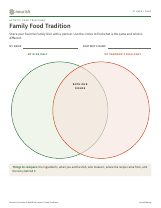
  • Round 2: group draws a 3-circle Venn diagram, one circle per member’s family tradition. Map shared elements in the overlaps, distinct elements in the outer segments.
  • Round 3: each group circles ONE thing they found surprising and ONE thing they all shared.
  • Circulate. Coach for respectful curiosity: every tradition matters.

Students

Share what you learned from your family or community interview.

Listen carefully to your groupmates.

Build a 3-circle Venn diagram showing what’s shared and what’s distinct across your three traditions.

Circle one surprise and one shared thing.

3

Class Cookbook entries

15 min

Teacher

  • Distribute the Class Cookbook entry template. Display the requirements: dish name + student name, ingredients list, one paragraph about the dish (story, who makes it, when it’s eaten), and optionally a drawing or photo.
  • Frame: “This is your contribution to a Class Cookbook, a shared record of the food traditions in this classroom.”
  • Circulate. Coach for specificity: the story is what makes the recipe meaningful.
  • Collect entries to be assembled into the Class Cookbook (paper-stapled or digital doc).

Students

Write your Class Cookbook entry: dish name, ingredients, and a short paragraph about the story of the dish.

Optional: add a drawing or photo.

4

Closing reflection

7 min

Teacher

  • Project the second Pollan quote: “Food is not just fuel. Food is about family, food is about community, food is about identity. And we nourish all those things when we eat well.”
  • Read aloud. Pause.
  • Direct students to write a brief paragraph in their notes: “What does Pollan’s quote mean to you? Use at least one example from your family interview or from your group’s Venn diagram.”
  • Close: “Every meal carries a story. Notice what tonight’s food might tell you about your family.”

Students

Listen to the second Pollan quote.

Write a brief paragraph: what does the quote mean to you? Use an example from your interview or your group Venn.

Assessment

What understanding looks like.

Students demonstrate understanding by:

  • Using vocabulary (food culture, food traditions, identity) accurately.
  • Conducting a respectful, focused interview with a family or community member and recording responses on the Interview page.
  • Contributing meaningfully to the small-group Venn diagram.
  • Writing a Class Cookbook entry that includes both a recipe and a story.
  • Connecting personal experiences to broader cultural and community contexts in the written reflection.

Look-fors: respectful listening matters as much as speaking. Students who ask follow-up questions of their interviewee are demonstrating SL standards strongly.

Differentiation & scaffolding

Build access in.

For multilingual learners

  • Dish names and food terms in any language are welcome and celebrated.
  • Students may interview a family member in their home language and translate the highlights for the class.
  • Allow written reflections in a home language alongside English.

For students with sensitive family situations

  • Allow students to interview a school cafeteria worker, teacher, family friend, or older sibling if home traditions aren’t accessible.
  • Never require students to share publicly; small-group is enough. Some students may prefer to write instead of speak on Day 2.

For students who finish early on Day 2

  • Sketch an illustration of one dish for the Class Cookbook.
  • Interview a fourth person (a teacher or school staff member) as a bonus.

Context notes

Set the tone first. Some students may be embarrassed about their food, especially in classrooms where culinary diversity is high. Establish from minute one that every food tradition has value, that curiosity is the right response to difference, and that no one’s family food is “weird”, only different from what others know. Model genuine curiosity yourself.

Interview return-rate. Not every student will complete the take-home interview. Have a backup ready: students who didn’t interview can pair with a completed classmate on Day 2, or interview a school staff member during the mini-share.

Extensions

Five ways to go further.

Extension 01

Class Community Cookbook (extended version)

Expand the Day 2 Cookbook contribution into a fuller class project. Students add photos, illustrations, or brief interview clips. Send bound or digital copies home and consider sharing with the school library.

Extension 02

Global Food Traditions Through Photos

Students analyze photos from the Hungry Planet: What the World Eats online resource by Peter Menzel and Faith D’Aluisio. Across 41 country images, students compare food traditions and identify how culture, geography, and economic opportunity shape what people eat.

Extension 03

Mapping Our Global Foods

Students find foods in their kitchens or local grocery stores that come from other countries and document them with photos. They map their findings on a classroom world map or in Google Maps, visualizing how global food systems connect to everyday lives.

Extension 04

Interview an Elder

Students conduct a longer, more structured interview with an older family or community member (30–45 minutes) about how food traditions and diets have changed over time. Sample questions: What did you eat for breakfast/lunch/dinner growing up? Where did your food come from? Did you grow any of it? Did your family preserve food from season to season? Students produce a short written or audio piece.

Extension 05

Food Tradition Story Writing

Students write a one-page narrative about a meaningful meal in their family: a holiday gathering, a Sunday dinner, a birthday dish. They use sensory details and at least one piece of dialogue.