The story of food traces a path from farm to fork.
 Grade
 Time
 Final product
Every food has a story: when, where, why, and how it traveled from its source to our plates, and who was involved along the way. Reading those stories helps us understand food systems and make conscious choices.
How does food move from farm to table and back to the soil, and why does it matter?
Across two class periods, students learn that every food has a story, and that they can read parts of that story from labels and packaging.
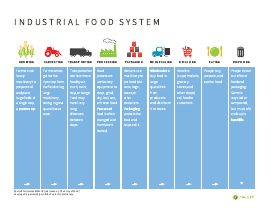
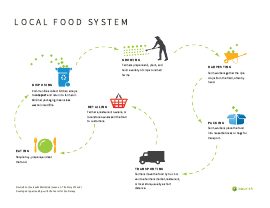
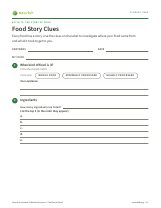
Day 1 opens with the Nourish short film Whole and Healthy, which introduces the whole-vs-processed distinction, builds shared vocabulary through the industrial and local food system diagrams, and lets pairs investigate real food labels using the Food Story Clues page. Day 2 challenges pairs to build a Food Story creative artifact (a poster, slide deck, short video, or infographic) tracing one food from farm to table and back to the soil, then share it in a class gallery.
By the end, students see food systems as interconnected webs of people, places, and choices, and recognize themselves as participants who can ask better questions about what’s on their plate.
Develop and use a model to explain how food moves through systems of production, processing, distribution, consumption, and waste. Apply scientific principles to evaluate how food systems impact the environment and human well-being.
Three-dimensional emphasis. SEPs: Developing and Using Models; Obtaining, Evaluating, and Communicating Information. CCCs: Systems and System Models; Cause and Effect.
MS-LS2-3 MS-ESS3-3Integrate information from labels, diagrams, texts, and media to explain the story of a food. Write or produce an informative Food Story artifact using evidence. Engage in collaborative discussions about food systems.
RST.6-8.7 WHST.6-8.2 SL.6.1/7.1/8.1Explain how economic decisions in food production and consumption affect the well-being of individuals, businesses, and communities. Explain how environmental and cultural factors influence food systems. Evaluate how individual and community choices can shape sustainable food systems.
D2.Eco.1.6-8 D2.Geo.4.6-8 D2.Civ.12.6-8Explain how levels of food processing connect to personal and community health. Analyze how food system practices influence health outcomes. Advocate for food choices that support human and environmental health.
NHES 1 NHES 2 NHES 8All of our food has a story. Each story includes when, where, why, and how a food travels from its original source to our plates, and who is involved along the way.
For example, a box of corn chips might begin on a thousand-acre conventional corn farm in Iowa, travel by truck to a processing plant in Illinois, then to packaging, then by truck again to a grocery store. An heirloom tomato at a farmers market might come from a small farm twenty miles away, picked the day before. Both stories are part of a food system: all the people, places, and steps that bring food to a community. By becoming more aware of food systems, students can begin to make conscious choices about what they eat and who they support.
Labels are a good place to begin investigating a food’s story, but they tell only part of it. Full stories require research, inference, and sometimes creative sleuthing: the kind of critical reading students will practice as they examine real packages on Day 1.
Introduce Set A on Day 1; let Set B emerge as students read labels.
All the people, places, and steps involved in bringing food to our community.
A system that produces large amounts of food using machines, chemicals, and long-distance transportation.
A system that produces and sells food close to where people live.
Food that is close to how it comes from nature, with few or no added ingredients (an apple, an egg, brown rice).
Food that has been changed from its natural form, often with added sugar, salt, or preservatives.
See every term in the Visual Glossary
Set B, Encounter as you readA field planted with only one type of crop.
A basic farm product, like corn, wheat, or soybeans, grown in huge amounts and bought and sold around the world.
Food scraps and yard waste broken down into nutrient-rich soil.
Google files open as your own editable copy. Want it all? Download the whole lesson in one ZIP. Teaching the whole unit? Download all 7 lessons or open the unit in Google Drive.
Share with a partner: one surprise from the film, plus one food you ate recently, and whether it was whole or processed.
Add examples to the whole/processed lists on the board.
Share one similarity and one difference between the two systems.
Consider: is your family’s food more industrial or local? What clues would tell you?
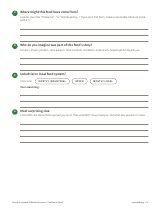
Answer each question on the Food Story Clues page. Mark guesses with a question mark.
Discuss ingredients, likely origins, and the people involved in your food’s story.
Circle the one most surprising clue you found.
Share the most surprising clue your pair found.
Reflect: Is your food more industrial or local? Why do you think so?
Pass in your Food Story Clues page.
Review your Food Story Clues page with your Day 1 partner.
Choose your format: poster, slide deck, short video, or infographic.
Create your Food Story artifact together: use color, images, short labels, and at least 3 unit vocab words.
Show four story stops: where it grew, who handled it, how it traveled, what happens to waste.
End with a “Big surprise” line: one thing you want classmates to remember.
Visit at least 3 other pairs’ artifacts.
Leave one specific sticky note at each station you visit.
Return to your station and read what others wrote about your food.
Share one observation from the gallery walk.
Notice patterns across your classmates’ food stories.
Students demonstrate understanding by:
Look-fors: pairs that mark inferences with a question mark, rather than guessing confidently, demonstrate stronger informational reading.
Family food choices are personal. Some students may feel called out if their family relies heavily on processed foods (often because of time, cost, or access). Treat all food choices respectfully: the lesson is about learning to ask questions, not judging plates.
Ingredient origins are often guesses. Many labels don’t show country of origin. Reasonable inference, clearly marked, is part of strong informational reading.
Students choose a favorite food they eat regularly and tell its full story: people, places, and steps required to get the food from its source to their plate. They write a half-page “Food Story” and share it with the class.
Arrange a class visit to a farmers market and/or supermarket. Compare and contrast the foods for sale and how they’re presented. How many foods are marketed as local? Students compare cost, packaging, origin, and visual appeal across the two settings, then build a short comparison report.
Students prepare 3-question interviews with a farmer, grocer, cafeteria manager, or food-truck owner to learn how food moves through the local food system and compare it to industrial pathways. They synthesize what they hear into a one-page profile.
Students research how much of a food dollar goes to farmers and discuss how different food systems affect farmer livelihoods. Builds quantitative literacy. Pair with a class chart showing the breakdown.
Students choose one stage of the food system (farming, processing, transportation, retail, or waste) and design a way to make that stage better for people, animals, or the planet. They present their idea as a 2-minute pitch with a poster or slide.