A celebration of learning and community.
 Grade
 Time
 Final product
Sharing what we’ve learned about the food system invites our community to act.
How do we share what we’ve learned to inspire awareness and action in our community?
In this culminating experience, students bring together what they have learned across the Nourish unit by curating an Expo station. Working in pairs, they choose work from earlier lessons that tells a clear story about food and the food system, design a display, and present it to an audience: their class, other classes, or family and community guests.
The Expo serves as both a celebration of learning and an opportunity for students to practice communicating key concepts through visuals, data, and storytelling.
Obtain and combine information from multiple sources to explain how communities can protect Earth’s resources through food system choices.
Three-dimensional emphasis. SEP: Obtaining, Evaluating, and Communicating Information. CCC: Systems and System Models.
5-ESS3-1Conduct short research projects using multiple sources. Write informative texts using facts, details, and visuals. Present ideas clearly using visual displays and supporting evidence.
W.5.7 W.5.2 SL.5.4Illustrate ways individuals and groups can change food systems for the better. Explain how individual and group actions can address community challenges. Explain how human settlements and movements relate to the use of natural resources.
D2.Civ.14.3-5 D2.Civ.12.3-5 D2.Geo.8.3-5Communicate ideas that promote healthy food choices and community well-being. Advocate for behaviors and solutions that support healthier people, communities, and environments.
NHES 4 NHES 8Over the course of this unit, students have explored the story of food: how it’s produced (Lessons 1, 5), how it’s affected by season and place (Lesson 2), what it means to families (Lesson 3), what happens when it’s wasted (Lesson 4), how it’s grown (Lesson 5), and what data reveals about food in our community (Lesson 6).
The Food System Expo mirrors a real-world showcase, where scientists, community organizations, and advocates share findings to educate and inspire change. A pair might build their whole station around food waste; another around the journey of one food from soil to plate; another around their community’s farmers’ market. Encourage this focus: curation, not comprehensiveness.
Google files open as your own editable copy. Want it all? Download the whole lesson in one ZIP. Teaching the whole unit? Download all 7 lessons or open the unit in Google Drive.
Courtesy of Hutchins Farm: Real Organic Certified
Watch Be the Change and listen for one ripple you’d want to start.
Add a word to the class board.
Look silently at all your Nourish work for 5 min.
Pick 2–3 pieces you’re proud of.
Notice: which pieces feel like part of the same story?
Pair up with a partner.
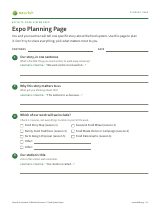
Use the Planning Page to land on ONE story.
Pick the 3–5 pieces of prior work that best tell that story.
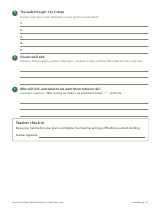
Sketch your station on the back of your Planning Page.
Label your 3–5 stops.
Get teacher sign-off before the next class.
Re-read your plan to your partner.
Confirm your story before starting to build.
Lay out your prior work and decide where each piece goes.
Add a title for your station and captions for each piece.
Outline pencil work with thin black marker for visibility.
Swap and give feedback at the 25-min mark.
Bring any food packaging, photos, or props you’d like to add tomorrow.
Spell-check, neaten marker lines, add final visuals.
Stand back and look at your station: does the story read?
Welcome visitors to your station.
Walk them through your 3–5 stops in about 60 seconds.
Answer questions; ask visitors what they noticed.
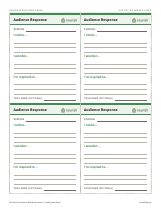
When it’s your turn to circulate, visit at least 3 other stations and leave a card at each.
Read your visitor cards with your partner.
Listen to Nourish Means… and notice how others answer the question.
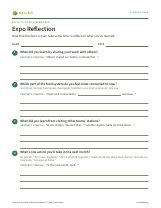
Begin your Student Reflection Page.
Students demonstrate understanding by:
Look-fors: students may show understanding through visual design, written captions, oral explanations, or a combination. The Teacher Setup Guide includes a simple rubric.
Open the Expo to families, school staff, and local community partners: a farmer, food bank volunteer, school nutrition lead, or community gardener. Send invitations a week in advance (template in the Teacher Setup Guide). Encourage guests to leave Audience Response Cards alongside student visitors. Builds civic identity and turns the Expo into a community event.
Invite a younger grade (K–3) to visit the Expo, with each station prepared to teach younger students about their food-system topic. Students adapt their explanations for a younger audience, a powerful exercise in clarity. For an older grade (Middle or High School visiting), encourage debate-style follow-up questions.
Each student writes one concrete action they will take in the next four weeks to influence the food system: eat one new fruit or vegetable each week, talk to family about one farming choice, start a small herb garden, donate to a food bank. Track for four weeks with weekly check-ins. Connects the Expo’s communication work to new practices.
Partner with a local food bank, community garden, school cafeteria, or farm for a hands-on service project that builds on what the class learned. Choose the partner based on which Expo themes emerged most strongly: a food-waste-focused class might serve at a food rescue organization; a farming-focused class might volunteer at a community garden.
Pairs record a 60-second video walking through their Expo station (tablet or phone). Compile videos into a class playlist and share with families via email, the school website, or a private YouTube channel, extending the Expo to families and community members who couldn’t attend in person. A nice way to honor the work after the physical Expo ends.