Elementary School

Food and Farming

The story of food often begins on a farm.

Courtesy of Red Door Farm: Real Organic Certified
Lesson
05 / 07 Download this lesson
Grade
Grades 4–5
Time
Two class periods, 45–50 min each
Final product
Farm Design Proposal, shared in a gallery walk
Big idea

Every farming method involves choices and trade-offs. Communities choose farms that reflect what they value most.

Essential question

How do different types of farming affect the health of people and the environment?

Activity overview

Compare, choose, advocate.

Across two class periods, students compare four farming approaches (conventional, organic, regenerative, and urban) and then act as farm advisors for a fictional Community Land Board considering a piece of open land in their own community.

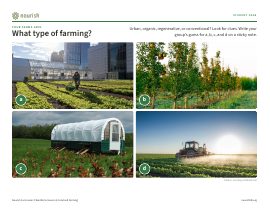
Day 1 opens with the Nourish short film Second Barcode, then a Four Farms Guessing Game where table groups examine printed farm images and predict which is which before the teacher reveals the four types. Students then jigsaw the Farming Guides to build shared vocabulary. Day 2 challenges teams to design a farm proposal for OUR community and share it via a gallery walk.

By the end, students understand that every farming method involves choices, and that the “best” farm depends on what a community values.

The Four Farms Grid, a Day 1 guessing game
a Urban
b Organic
c Regenerative
d Conventional
Standards alignment

Four subjects, one lesson.

Science (NGSS)

What students do

Obtain and combine information from multiple sources about how different farming practices affect soil, water, and ecosystems.

Three-dimensional emphasis. SEP: Obtaining, Evaluating, and Communicating Information. CCC: Cause and Effect.

5-ESS3-1
ELA (CCSS)

What students do

Integrate information from several sources on the same topic. Engage in collaborative discussions. Write a persuasive Farm Design Proposal.

RI.5.7   RI.5.9   SL.5.1   W.5.1
Social Studies (C3)

What students do

Explain how human settlements and movements relate to the locations and use of natural resources. Compare costs and benefits of farming choices. Illustrate ways individuals and groups can change food systems for the better.

D2.Geo.8.3-5   D2.Eco.1.3-5   D2.Civ.14.3-5
Health (NHES)

What students do

Explain how different farming practices affect soil, water, and human health. Analyze influences on personal and environmental health. Advocate for community health.

NHES 1   NHES 2   NHES 8
Background for teachers

Four approaches in plain language.

Farmers operate their farms in different ways, reflecting where they live, what they grow, what they learned, and what they value. Four common approaches are described below. In real life, many farms mix elements from more than one.

Conventional

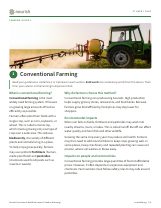
Focuses on producing large amounts of food efficiently. Often uses machinery, synthetic fertilizers, and pesticides. Much of the world’s food is grown this way.

Organic

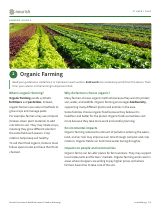
Avoids synthetic chemicals and follows certified standards. Uses natural soil and pest management practices like crop rotation and beneficial insects.

Regenerative

Treats soil as a living system and aims to restore it. Practices include cover crops, low or no tillage, composting, and managed grazing.

Urban

Grows food inside cities: community gardens, school gardens, rooftops, vacant lots, container farms, greenhouses. Often serves neighborhoods that have less access to fresh produce.

Vocabulary

Two sets, one timing rule.

Vocabulary is introduced in two sets. Front-load only the six core terms before Day 1’s Step 2 vocab preview; let the rest emerge naturally from the Farming Guide reading.

Set A, Need to know first (introduce on Day 1)

farming

The work of growing plants and raising animals, mostly for food.

conventional farming

A way of farming that uses chemicals and big machines to grow large amounts of food.

organic farming

A way of farming that avoids human-made fertilizers and pesticides to protect soil, plants, and animals.

regenerative farming

A way of farming that restores soil, water, and biodiversity, leaving the land healthier than before.

urban farming

Growing food in city spaces like community gardens, school gardens, rooftops, and indoor farms.

trade-off

Choosing one thing means giving something else up.

Set B, Encounter as you read (in the Farming Guides)

fertilizer

Something added to soil to help plants grow, made by people (synthetic) or from natural sources like compost.

pesticide

A chemical used to kill pests that damage crops.

biodiversity

The variety of living things in an area, from plants and animals to the life in the soil.

Materials & preparation

What you’ll print and cue up.

Materials

  • Nourish short film: Second Barcode (Michael Pollan, ~2 min): Pollan imagines a bar code that could tell us the full story of where our food comes from.
  • Visual glossary slides: one per term.
  • Four Farms Grid: printable PDF with 4 farm images, 1 per table group for the Day 1 guessing game. Also projected for the whole-class reveal.
  • Farming Guides: printable PDF, 4 different guides: Conventional, Organic, Regenerative, Urban; 1 per student.
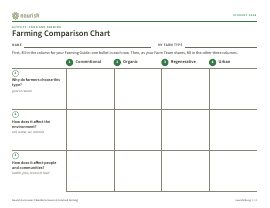
  • Farming Comparison Chart: printable PDF, 1 per student; three rows × four columns.
  • Farming Comparison Chart: Teacher Answer Key: filled-in reference; use as a live discussion guide during Day 1 report-outs, or project as an optional class synthesis after student groups share. 1 per teacher.
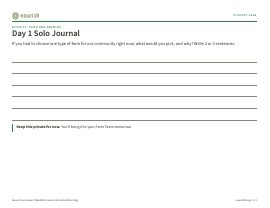
  • Day 1 Solo Journal: prints on the back of the Comparison Chart.
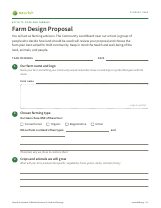
  • Farm Design Proposal: printable PDF, 1 per team; Day 2 team template.
  • Sticky notes: small pad per student for group guesses on Day 1 and gallery walk feedback on Day 2.
  • Optional: slide tool, chart paper, or markers for teams choosing to build a slide deck or poster proposal.

Preparation

  • Cue up the Nourish short film Second Barcode for Day 1, Step 1. Confirm video and audio play, and turn on captions.
  • Cue up the Food and Farming Visual Glossary slides; used for the Step 2 vocab preview (4 farming type slides) and as a reference throughout Day 1.
  • Print the Four Farms Grid; one copy per table group (4–5 students each). Also cue up the projected version for the reveal.
  • Print 4 Farming Guides (enough for the jigsaw process) or share digitally.
  • Print the Farming Comparison Chart with Solo Journal on the back (1 per student) and the Farm Design Proposal (1 per team).
  • Decide whether students will work in Day 1 jigsaw teams of 4 OR self-selected pairs for Day 2; both work (see Differentiation).
  • Optional: skim the Farming Comparison Chart: Teacher Answer Key before teaching. Cue it on your projector if you plan to use the optional class-synthesis reveal in Day 1, Step 4.

Download this lesson.

Teacher materials: the teacher guide and the lesson slides

Google files open as your own editable copy. Want it all? Download the whole lesson in one ZIP. Teaching the whole unit? Download all 7 lessons or open the unit in Google Drive.

45 minutes

Day 1

Different types of farming.

Courtesy of Better Together Farm: Real Organic Certified

1

Watch: Second Barcode

7 min

Teacher

  • Pre-frame: introduce the film. Ask students to look for one thing that surprises them about the story food could tell.
  • Play Second Barcode (~2 min). Captions on.
  • Pair share: one surprise from the film; whether they’ve visited a farm, garden, or farmer’s market.
  • Whole-class capture: Invite 2–3 students to share. Capture single words on the board (“tomatoes,” “workers,” “fields,” “chicken”).
  • Bridge: today we’ll meet four different ways that farms grow food.

Students

Share with a partner what surprised you and whether you’ve visited a farm, garden, or market.

Add a few words to the class brainstorm.

2

Vocabulary preview + Four Farms Guessing Game

10 min

Teacher

  • Vocab preview: click through the Food and Farming Visual Glossary slides for the four farming types, Conventional, Organic, Regenerative, and Urban. About 20 seconds each, reading the term and the definition. Students watch and listen.
  • Set up: hand out the Four Farms Grid, one per table group. Also project the grid. “Now let’s see if you can spot each of the four types in these photos.”
  • Table-group discussion: groups examine the images closely and match a/b/c/d to the four farming types. Record guesses on a shared sticky note (one per group). Circulate. Ask: “What clues are you using?”
  • Whole-class reveal: walk through the Grid, naming each farming type and 1–2 key visual features that gave it away. Legend: a. Urban, b. Organic, c. Regenerative, and d. Conventional. Groups tally hits.
  • Consolidation + Set B preview: quickly restate the four farming types. Preview the other Glossary terms (fertilizer, pesticide, biodiversity, trade-off), which students will meet in the Farming Guide reading. The full Glossary can stay projected or on the wall as a reference.

Students

Watch the Visual Glossary preview and listen for what makes each farming type different.

In your table group, look closely at the Four Farms Grid. Which type is a? b? c? d?

Write your group’s four guesses on a sticky note.

During the reveal, tally how many you got right.

Notice the four other Glossary terms you’ll see in the reading.

3

Read a Farming Guide

11 min

Teacher

  • Assign each student to one of the four farming types (count off 1–4, or assign by table).
  • Distribute Farming Guides and the Farming Comparison Chart.
  • Direct students to read silently and fill in only the column of their assigned farm. The chart has three rows that mirror the headers in the Farming Guide.
  • Set a visible timer: 10 min reading + 2 min for chart. Circulate.

Students

Read your Farming Guide silently.

Underline 2–3 phrases for each section of the guide.

Fill in your column of the Farming Comparison Chart: one bullet per row.

4

Jigsaw: form Farm Teams

13 min

Teacher

  • Form Farm Teams of 4: one expert from each farming type.
  • Project the sentence stem so all four experts use a parallel frame: “My farm type is … The biggest benefit is … A trade-off is …”
  • Set a visible 90-second timer per expert, then 7 min for clarifying questions and notes.
  • Circulate. Listen for misconceptions.
  • Optional class synthesis (if time allows): project the Farming Comparison Chart: Teacher Answer Key one row at a time. Confirm what the class got right, gently correct any gaps, and name one trade-off per archetype. Skip if the 13 minutes are already spoken for.

Students

Take turns teaching your farm type using the projected sentence stem for 90 seconds each.

While listening, fill in the other three columns of your Comparison Chart.

Ask one clarifying question of each presenter.

5

Solo Journal + preview Day 2

4 min

Teacher

  • Project the prompt: “If you had to choose one type of farm for OUR community right now, what would you pick, and why?”
  • Ask students to write 2–3 sentences in the Day 1 Solo Journal box on the back of their Comparison Chart (private, not shared yet).
  • Preview Day 2: tomorrow students will be farm advisors making a recommendation to the Community Land Board.

Students

Write 2–3 sentences naming your current preference and your reason.

Keep this private; you’ll bring it to your team tomorrow.

45–50 minutes

Day 2

Farm Design Challenge

Courtesy of Racing Heart Farm: Real Organic Certified

1

Launch the Land Board Challenge

5 min

Teacher

  • Read aloud the Community Land Board scenario: “The Community Land Board has an important decision about a piece of open land in our community. They’ve invited your team to submit a proposal for what kind of farm to build there. Your job is to decide what type of farm offers the best option for OUR community, and to defend your choice with evidence.”
  • Emphasize OUR community: name the actual city, town, or neighborhood your students live in.
  • Distribute the Farm Design Proposal (1 per team).

Students

Listen to the scenario.

Re-join your Day 1 Farm Team (or partner).

Pull out your Farming Comparison Chart and Day 1 Solo Journal.

2

Farm Team discussion

10 min

Teacher

  • Project discussion stems: “I think this is best because…” “A challenge might be…” “What matters most for OUR community is…”
  • Circulate with prompts: “What trade-offs do you notice?” “Who benefits most?” “How does this fit our community?”
  • Teams may choose one of the four types OR check Blended on their proposal and explain.

Students

Each team member shares their preference.

Discuss strengths, trade-offs, and community fit using the stems.

Choose a preferred farming type, or argue for a blend.

3

Build the Farm Design Proposal

20 min

Teacher

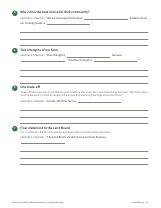
  • Display proposal requirements (also printed on the Proposal): farm name + logo, chosen farming type (or blend), crops and animals you’ll grow, why this is best for OUR community, two strengths and one trade-off, final statement to the Land Board.
  • Set a visible timer at 18 min; reserve the last 2 min for teams to read it through and decide who will speak at the gallery walk.
  • Optional upgrade for fast teams: turn the proposal into a poster, slide, or sketched farm map.

Students

Complete the seven sections of the Farm Design Proposal as a team.

Focus on clear reasoning and evidence from your Farming Guide and Comparison Chart.

Decide who will speak at the gallery walk and what they’ll highlight.

4

Gallery walk + sticky-note feedback

10 min

Teacher

  • Have teams post their proposals around the room (taped to walls or laid on desks).
  • Give each student 3 sticky notes. Direct them to leave one of three kinds of feedback at each station they visit:
    • “I notice…” (something specific)
    • “I wonder…” (a question or push)
    • “I’d choose this because…” (a vote with reasoning)
  • One team member stays at the station to answer questions when visited.
  • Time it: 8 min circulating + 2 min back at own station to read feedback.

Students

Visit at least 3 other teams’ proposals.

Leave one specific sticky note at each station you visit.

Return to your station and read what others wrote about your farm.

5

Closing reflection

5 min

Teacher

  • Lead a quick whole-class reflection. Ask one or two of: Did most teams choose the same type of farm? What surprised you? Did anyone choose a farm because of something they’ve seen in their own neighborhood? Is there one clear “winner”, or does it depend on what a community values?
  • Close: communities weigh strengths and trade-offs: there is rarely one perfect answer.

Students

Share one trade-off your team weighed.

Notice what your classmates chose and why.

Assessment

What understanding looks like.

Students demonstrate understanding by:

  • Using vocabulary (conventional, organic, regenerative, urban, trade-off) accurately in discussion and writing.
  • Summarizing their assigned farming approach on the Farming Comparison Chart.
  • Identifying at least two strengths and one trade-off for their chosen approach.
  • Comparing farming types and explaining trade-offs in the team proposal.
  • Using evidence from the Farming Guides to describe effects on people and the environment.
  • Communicating ideas clearly during the jigsaw teach-back and the gallery walk.

Look-fors: students may show understanding through speech, writing, drawing, or a sketched farm map. All four are valid.

Differentiation & scaffolding

Build access in.

Day 2 grouping flexibility

  • Two strong options for Day 2 group structure:
  • Jigsaw teams of 4 (default): Teams stay together from Day 1. Brings four areas of expertise into the proposal discussion, so the conventional expert pushes back on the urban expert’s claims. Best when class discussion dynamics are strong.
  • Self-selected pairs: Students pair up at end of Day 1. Less discussion friction, more individual engagement, faster decision-making. Best for younger ES students or classes new to project-based work.

For multilingual learners

  • Use the projected sentence stems during the jigsaw teach-back and the Day 2 discussion.
  • Pre-teach Set A vocabulary with the visual on each slide.
  • Allow the Farm Design Proposal to be drafted partly in a student’s home language.

For students with reading IEPs or who benefit from audio

  • Provide the Farming Guides in audio (text-to-speech) format.
  • Offer a pre-highlighted version of the guides for students who would benefit.
  • Pair partners so that an audio listener has a strong peer reader nearby.

For students who finish early

  • Add a second column on the Comparison Chart: “What questions do I still have?”
  • Begin sketching a labeled farm map for the team product (Day 1 head start).

Context notes

Urban context. Most students learning this lesson will be in urban communities. When teaching Urban Farming, lean on images that look like the cities your students actually live in: community gardens, school gardens, rooftops, and indoor farms.

Rural context. In rural districts, many students have family members in conventional agriculture. Treat conventional farming as a real choice made under real constraints (cost, weather, scale, family history).

Extensions

Five ways to go further.

Extension 01

Land Board Day

Extend to a third day with formal Land Board pitches. Each team gives a 2-minute presentation of their proposal to the class acting as the Land Board, followed by one focused question per team. Conclude with a class vote; students may not vote for their own proposal. Adds public speaking, peer accountability, and the dramatic civic moment of a community decision being made.

Extension 02

Persuasive Writing

Students write an individual letter to the Community Land Board defending their chosen farming practice. They must include evidence from the Farming Guides, explain one trade-off honestly, and advocate for future generations of the community.

Extension 03

Local Farming Research

Students investigate what types of farms exist in their region or state. Are they mostly conventional, organic, regenerative, or urban? Why? How does climate or geography influence farming choices?

Extension 04

Systems Map

Students create a systems map showing how their chosen farming type affects soil, water, animals, farmers, workers, customers, and climate. Arrows show cause-and-effect relationships. The finished map is an art-rich artifact for display.

Extension 05

Guest Speakers

Invite a local farmer, gardener, land-use planner, or food-system advocate to share their work, or arrange a class visit to a local farm or community garden. Provide students with a 3-question interview template in advance. Students record one new insight and connect it back to the four farming types studied in the lesson.