The story of food includes where it’s grown, and when.
 Grade
 Time
 Final product
Foods have seasons. When we eat food that’s in season and grown nearby, we get fresher food, support local farms, and use less energy moving food around.
Why does it matter when and where our food is grown?
Across two class periods, students learn that foods have seasons, and that eating in-season, locally grown food has real benefits for taste, freshness, farmers, and the planet.
Day 1 opens with a sensory tasting of a local in-season food, builds vocabulary, and introduces the color-coded Seasonal Food Wheel. Students begin filling it in for their region. Day 2 finishes the Wheels, then students walk a small-group gallery to compare what’s in season near them.
The lesson closes with a discussion of trade-offs: local food is fresher and uses less fuel, but isn’t always available. Students take their finished Wheels home to share with families.
Obtain and combine information about ways individual communities use science ideas to protect Earth’s resources and environment.
Three-dimensional emphasis. SEP: Analyzing and Interpreting Data. CCC: Patterns.
5-ESS3-1Interpret information from a seasonal calendar and a regional map. Write informative descriptions of seasonal foods. Engage in collaborative discussions about food choices.
RI.4.7 RI.5.7 W.4.2 W.5.2 SL.4.1 SL.5.1Explain how environment and climate influence what people eat. Explain how human use of natural resources varies by place. Compare benefits and trade-offs of local and distant food.
D2.Geo.4.3-5 D2.Geo.8.3-5 D2.Eco.1.3-5Identify how seasonal eating affects nutrition. Analyze influences on food choices. Practice self-management of healthy food choices.
NHES 1 NHES 2 NHES 7One important part of the story of food is how far it travels and when it was harvested. In the past, most people grew or gathered food close to home. Today, much of our food travels long distances (sometimes across countries or continents) before reaching our plates.
When fruits and vegetables travel a long way, they’re often picked before they’re ripe so they can survive the journey. They may be less flavorful, less nutritious, and use more fuel and packaging to reach us. Eating locally grown foods in season can support nearby farmers, reduce transportation pollution, and provide fresher, tastier food.
But eating only local foods isn’t always possible, and that’s okay. In many regions, the seasonal variety is limited, and a balanced diet may include foods grown elsewhere.
Introduce the four core terms on Day 1 before the Seasonal Food Wheel.
Ripe and ready to harvest nearby, in the months when a food naturally grows.
Food grown and produced close to where it is eaten, usually within the same region.
The area where food is grown and produced to feed the people who live there, like a watershed but for food.
Choosing one thing means giving something else up.
Google files open as your own editable copy. Want it all? Download the whole lesson in one ZIP. Teaching the whole unit? Download all 7 lessons or open the unit in Google Drive.
Taste the food and notice how it tastes and smells.
Guess where it came from and what season it grows in.
Share your guess with a partner, then the class.
Guess which food is local and which traveled far.
Learn the four core terms.
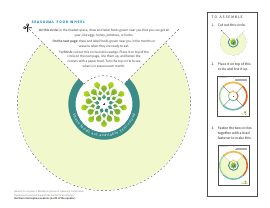
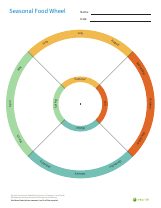
Notice the four season colors, where each month falls, and the center circle for year-round foods.
Use the regional chart to find foods in season for each month.
Draw and label at least 2 foods in each season’s color band.
Add at least 2 year-round foods to the center circle.
Share one food on your Wheel that surprised or excited you.
Store your Wheel pages carefully.
Finish drawing and labeling local foods on your Wheel.
Assemble the Wheel: cut the wedge, stack, fasten with a brad.
Share your Wheel with your group.
Walk among the Wheels and write down one new food from each.
Share one benefit and one trade-off of eating local, in-season food.
Listen to your classmates’ ideas. Add to the class chart.
Write your name on the back of your Wheel.
Take your Wheel home and show one family member.
Ask them: what season foods do you remember from when you were a kid?
Students demonstrate understanding by:
Look-fors: drawings + labels are both valid. Students may know more about foods in some seasons than others; that’s part of the learning.
Local food access varies. Some students live in neighborhoods with farmers markets and full grocery stores; others live in food deserts where local in-season food is hard to find. Don’t presume access; invite the discussion. Trade-offs apply here, too.
Climate context. If your region has a long growing season, the Wheel will be full. If you teach in a colder climate (Northeast, Upper Midwest, Alaska), winter may rely heavily on stored or preserved foods (root vegetables, grains, eggs, dairy). Both are valid local food systems.
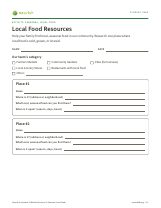
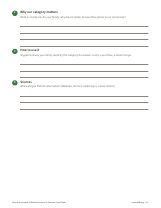
Students work in small teams to research nearby places where their family could find local food: farmers markets, CSAs, community gardens, food co-ops, school gardens, restaurants that source local. Each team contributes one page (place name, address, what’s sold, what season). Pages are assembled into a class “Where to Find Local Food” mini-book that goes home to families. Uses the Local Food Resources student page.
Students use a regional map and a compass (geometry tool) to draw a 150-mile (240-kilometer) circle around their school or town. They explore what farms, towns, agricultural areas, and waterways fall inside the circle, and discuss whether that’s a good way to define “local.” Strong math + geography integration.
Students use their Seasonal Food Wheels to plan a one-dish meal made entirely from foods in season locally. They identify the dish, list ingredients (with seasons), and write a paragraph explaining their choices. If kitchen access allows, the class prepares and tastes one of the dishes together.
Arrange a class visit to a local farm, farmers market, or school garden. Before the visit, students generate three questions about what grows there and when. During the visit, students interview a farmer or vendor. After, students update their Seasonal Food Wheels with anything new they learned.
Students write a short story (one page) from the point of view of a food traveling through its season: from sprouting in early spring, to growing in summer, to being harvested and eaten in fall.