Elementary School

The Story of Food

Every food has a story, and we can learn to read it.

Courtesy of Green Table Gardens: Real Organic Certified
Lesson
01 / 07 Download this lesson
Grade
Grades 4–5
Time
Two class periods, 45 min each
Final product
Food Story poster, shared in a gallery walk
Big idea

Every food has a story: where it came from, who grew it, how it traveled, what happened to leftovers. We can learn to read that story by looking at labels and asking questions.

Essential question

How does food get from a farm to our table, and back to the soil?

Activity overview

Read the label, tell the story.

Across two class periods, students learn that every food has a story, and that we can read parts of that story from labels and packaging.

Day 1 opens with the Nourish short film Whole and Healthy, builds shared vocabulary, and lets students explore real food labels in pairs using the Food Story Clues page. Day 2 challenges pairs to create a Food Story poster that traces one food from farm to table and back to the soil, then share their poster in a class gallery walk.

By the end, students understand that food systems involve many people, places, and choices, and that citizens can ask questions about where their food comes from.

Standards alignment

Four subjects, one lesson.

Science (NGSS)

What students do

Develop a model to describe the movement of matter among plants, animals, decomposers, and the environment, then apply it to the food system.

Three-dimensional emphasis. SEP: Developing and Using Models. CCC: Systems and System Models.

5-LS2-1
ELA (CCSS)

What students do

Interpret information from labels, diagrams, and texts. Write an informative Food Story poster. Engage in collaborative discussions about food and the environment.

RI.4.7   RI.5.7   W.4.2   W.5.2   SL.4.1   SL.5.1
Social Studies (C3)

What students do

Explain how culture and environment influence what we eat. Compare benefits and costs of food choices. Identify ways people and groups can shape food systems.

D2.Geo.4.3-5   D2.Eco.1.3-5   D2.Civ.14.3-5
Health (NHES)

What students do

Identify how food processing affects health. Analyze influences on food choices. Advocate for food choices that support people and the planet.

NHES 1   NHES 2   NHES 8
Background for teachers

What to know before you teach.

Every food has a story to tell. That story includes where, when, why, and how a food traveled from its original plant or animal source to our plates, and who was involved along the way.

Two very different stories help frame the lesson. A box of corn chips might begin on a thousand-acre conventional corn farm in Iowa, travel by truck to a processing plant in Illinois, then to packaging, then by truck again to a grocery store. An heirloom tomato at a farmers market might come from a small farm twenty miles away, picked the day before.

Both stories are part of a food system: all the people, places, and steps that bring food to a community. By becoming more aware of food systems, students can begin to make conscious choices about what they eat and who they support. Labels are a good place to begin investigating a food’s story. The full story may require further research or conjecture.

Vocabulary

Two sets, one timing rule.

Introduce the first four terms on Day 1 before the label exploration. Let the rest emerge as students notice them on real labels.

Set A, Need to know first (Day 1)

food system

All the people, places, and steps involved in bringing food to our community.

whole food

Food that is close to how it comes from nature, with few or no added ingredients (an apple, an egg, brown rice).

processed food

Food that has been changed from its natural form, often with added sugar, salt, or preservatives.

ingredient

One of the things a food is made from.

Set B, Encounter as you review the two Food System diagrams (Day 1)

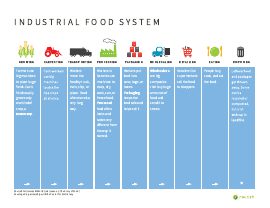
industrial food system

A system that produces large amounts of food using machines, chemicals, and long-distance transportation.

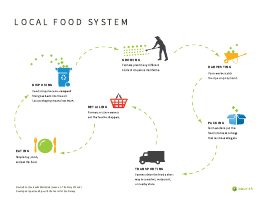
local food system

A system that produces and sells food close to where people live.

compost

Food scraps and yard waste broken down into nutrient-rich soil.

Materials & preparation

What you’ll print and cue up.

Materials

  • Nourish short film: Whole and Healthy (Dr. Nadine Burke, ~2 min): Dr. Burke explains the difference between whole and processed foods.
  • Visual glossary slides: one per term.
  • Food System diagrams: printable PDF, 1 per student or projected; Industrial Food System and Local Food System
  • Food labels and packaging bring a variety: produce stickers, dried beans, canned goods, dairy cartons, cereal boxes, snack bags. Plan for 1 item per pair.
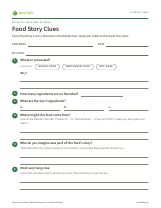
  • Food Story Clues student page: printable PDF, 1 per pair; guided questions for examining a food label.
  • Poster paper or chart paper and colored markers, OR a shared digital slide template; 1 per pair for Day 2.
  • Optional: atlas, regional map, or Google Maps for tracing where foods come from.
  • Sticky notes: small pad per student for gallery walk feedback on Day 2.

Preparation

  • Cue up the Nourish short film Whole and Healthy for Day 1, Step 1. Confirm video and audio play, and turn on captions.
  • Cue up vocabulary slides and the two Food System diagrams.
  • Collect food labels and packaging from a wide range of foods. Include both whole/minimally processed and heavily processed items. Bring real packages, not just photos, when possible.
  • Print the Food Story Clues student page (1 per pair) and decide whether posters will be paper or digital.
  • Decide pair groupings in advance. Day 2 work goes faster when pairs are pre-set.

Download this lesson.

Teacher materials: the teacher guide and the lesson slides
Food Story slide template: for pairs who build their Food Story as slides

Google files open as your own editable copy. Want it all? Download the whole lesson in one ZIP. Teaching the whole unit? Download all 7 lessons or open the unit in Google Drive.

45 minutes

Day 1

Reading a food’s story.

1

Watch: Whole and Healthy

7 min

Teacher

  • Pre-frame: introduce the film. Ask students to listen for one thing that surprises them about how food gets to us.
  • Play Whole and Healthy (~2 min). Captions on.
  • Pair share: one surprise, plus one food they ate recently whose origin they don’t know.
  • Whole-class capture: invite 2–3 students to share. Capture single words on the board.
  • Bridge: today we become food detectives, reading the story of real foods using their labels.

Students

Share with a partner what surprised you and a food whose story you don’t know.

Add a few words to the class brainstorm.

2

Vocabulary + Two Food Systems

8 min

Teacher

  • Project the vocabulary slides. Walk through Set A (four core terms) at a brisk pace: image first, then term, then definition.
  • Display the two Food System diagrams: Industrial Food System and Local Food System.
  • Ask what’s the same and what’s different across both systems. Invite 3–4 quick observations.
  • Highlight: every food goes through similar steps: growing, harvesting, transporting, eating, and dealing with waste. The two systems handle each step very differently.

Students

Read along with vocabulary; ask clarifying questions.

Compare the two diagrams side-by-side. Share one thing that is the same and one that is different.

3

Food Story Clues: pair investigation

25 min

Teacher

  • Pair students up and give each pair one food label or package plus a Food Story Clues page.
  • Walk through the first question together with the whole class, modeling how to find the answer on the label.
  • Set a visible timer at 20 min. Circulate with prompts about surprising ingredients, likely origin, and who was involved.
  • Encourage pairs to make a reasonable guess when a label doesn’t show the answer, and to mark it with a question mark.
  • 5 min before time: ask each pair to circle the ONE most surprising clue they found.

Students

Work with a partner to examine your food label.

Answer each question on the Food Story Clues page. Mark guesses with a question mark.

Discuss what ingredients you found, where the food might be from, and who is involved in its story.

Circle the one most surprising clue you found.

4

Closer + preview Day 2

5 min

Teacher

  • Invite 3–4 pairs to share their most surprising clue.
  • Ask whether their food is more industrial or more local, and why.
  • Preview Day 2: tomorrow, pairs will turn their discoveries into a Food Story poster.
  • Collect Food Story Clues pages for tomorrow.

Students

Share the most surprising clue your pair found.

Reflect: Is your food more industrial or more local? Why?

Pass in your Food Story Clues page.

45 minutes

Day 2

Food Story posters + gallery walk.

1

Re-orient + introduce the poster

4 min

Teacher

  • Return Food Story Clues pages to each pair.
  • Display the Food Story poster requirements on the board: name of the food, drawing of the food, four story stops (where it grew, who handled it, how it traveled, and what happens to waste), and a one-sentence “Big surprise” line at the bottom.
  • Model the poster structure quickly on the board using a sample food (e.g., a banana).

Students

Re-join your Day 1 partner.

Look over your Food Story Clues page together.

2

Build the Food Story poster

25 min

Teacher

  • Distribute poster paper (or open the slide template). Set a visible 25-min timer.
  • Circulate with prompts about evidence, gaps the label doesn’t cover, and clarity for a passer-by.
  • Optional: project Google Maps to help pairs locate where their food might have come from.
  • 5 min before time: ask each pair to write their one-sentence “Big surprise” line at the bottom.

Students

Create your Food Story poster together. Use color, simple drawings, and short labels.

Show four story stops: where it grew, who handled it, how it traveled, what happens to waste.

End with your “Big surprise” line: the one thing you want classmates to remember.

3

Gallery walk + sticky-note feedback

12 min

Teacher

  • Have pairs post their posters around the room.
  • Give each student 3 sticky notes. Direct them to leave one of three kinds of feedback at each station they visit:
    • “I notice…” (something specific in the story)
    • “I wonder…” (a question about the food)
    • “I’d ask the farmer…” (a question for whoever grew this food)
  • One partner stays at the station to answer questions when visited.
  • Time it: 10 min circulating + 2 min back at own station to read feedback.

Students

Visit at least 3 other pairs’ posters.

Leave one specific sticky note at each station you visit.

Return to your station and read what others wrote about your food.

4

Closing reflection

4 min

Teacher

  • Lead a brief whole-class reflection. Ask one of: What surprised you most across all the food stories? Which foods had the longest stories? Which had the shortest? What’s one question about food you have now that you didn’t have before?
  • Close: every food has a story: now students know how to read it and ask better questions.

Students

Share one observation from the gallery walk.

Notice the patterns across your classmates’ food stories.

Assessment

What understanding looks like.

Students demonstrate understanding by:

  • Using vocabulary (food system, whole food, processed food, ingredient) accurately in discussion and writing.
  • Completing the Food Story Clues page with reasonable answers and labeled guesses.
  • Producing a Food Story poster that shows the four story stops clearly.
  • Identifying at least one surprising fact about their food’s journey.
  • Comparing industrial and local food systems with evidence.

Look-fors: students may show understanding through drawing, labeling, speaking, or written reflection. All are valid.

Differentiation & scaffolding

Build access in.

For multilingual learners

  • Use the projected vocabulary slides during the label investigation: words paired with images make Set B easier to acquire in context.
  • Allow Food Story poster captions in a student’s home language alongside English.
  • Pair multilingual learners with classmates who share their home language whenever possible.

For students with reading IEPs

  • Provide pre-marked labels (highlight or underline key words like “ingredients,” “product of,” “distributed by”).
  • Use real foods alongside labels so the food is visible while the label is read.
  • Allow students to record their answers on the Food Story Clues page by speaking into a device that transcribes for them.

For students who finish early

  • Add a fifth story stop to the poster: “What happens to me after I eat this food?” (digestion → energy → waste).
  • Investigate a second food and compare its story to the first.

Context notes

Family food choices are personal. Some students may feel called out by the lesson if their family relies heavily on processed foods (often because of time, cost, or access). Treat all food choices respectfully: the lesson is about learning to ask questions, not about judging what’s on the plate.

Ingredient origins are often guesses. Many labels don’t show country of origin. Encourage students to make reasonable guesses and mark them clearly; guessing well is part of investigating.

Extensions

Five ways to go further.

Extension 01

The Story of My Favorite Food

Students take home a one-page handout and choose a favorite food they eat regularly. They interview a family member about where the food comes from, where the recipe comes from, and any family stories tied to it. They write a half-page “Food Story” of their favorite food and share it with the class.

Extension 02

Whole vs Processed Sort

Students bring in three labels or packages from home: one whole food, one minimally processed, and one heavily processed. As a class, build a whole-room continuum from “closest to nature” to “most processed.” Discuss the patterns: which foods have the most ingredients? The longest names? The most packaging?

Extension 03

Market or Cafeteria Visit

Arrange a class visit to a local farmers market, grocery store, or your own school cafeteria. Before the visit, students generate three questions based on what they learned in the lesson. During the visit, students interview a vendor, grocer, or cafeteria manager about how food gets to your community. After the visit, students compare what they observed to the Industrial and Local Food System diagrams.

Extension 04

Nourish Short Films Series

Students choose a short Nourish film from a teacher-curated list (Know Your Farmer, Fair Trade, Read Labels, What You Can Do) and share what they learned with a partner or the class. Each film is 1–3 minutes and connects to a different part of the food system story.

Extension 05

Design a Better Food System

Students choose one step of the food system (growing, transporting, packaging, eating, or waste) and design a way to make that step better for people, animals, or the planet. They sketch their idea and present it to the class as a 1-minute pitch.